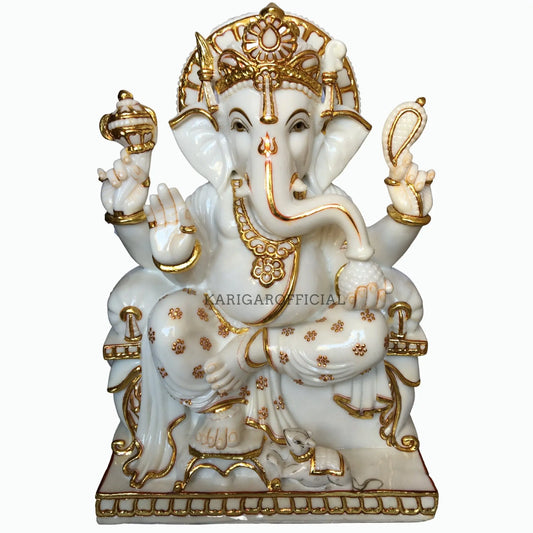
The complete Ganesh Ji statue buying guide
Choosing a marble Ganesha is not just a purchase — it’s a decision that stays with your home for generations. This guide walks you through every question our customers ask before committing.
1. The 32 forms of Ganesha — which form fits your intention
Hindu scripture (the Mudgala Purana) recognises 32 canonical forms of Lord Ganesha. The most popular forms we carve:
- Bala Ganapati — the child form, depicted holding fruits, sweets, and flowers.
- Taruna Ganapati — the youthful form, holding noose, goad, and fruits in his many arms.
- Bhakti Ganapati — the devotee’s form, radiant like the autumn moon, holding coconut, mango, banana, and a bowl of sweet porridge.
- Vira Ganapati — the valiant warrior form, depicted carrying many weapons.
- Shakti Ganapati — depicted seated with his Shakti (consort); invoked for family harmony.
- Siddhi Ganapati — the bestower of success; golden-hued, holding mango, flower, a bouquet of paddy, and his broken tusk.
- Heramba Ganapati — five-headed, ten-armed, seated on a lion; known in scripture as the “protector of the weak,” often chosen for temple installations.
- Nritya Ganapati — the dancing form; depicted dancing beneath the Kalpavriksha (wish-fulfilling tree).
- Lakshmi Ganapati — seated with two consorts; associated with wealth and prosperity.
- Maha Ganapati — the great form; red-complexioned, ten-armed, seated with his Shakti — suited to large temples and institutional altars.
- Vijaya Ganapati — the victorious; four-armed, depicted riding his mushaka (mouse).
- Ekadanta Ganapati — the single-tusked form; four-armed, classical and widely loved for home worship.
We carve all 32 forms to order. If you’re unsure which form is right for your home or temple, message our workshop on WhatsApp — we’ll recommend based on your intention and space.
2. Choosing your marble — Makrana, Ambaji, Vietnam, Rajnagar, or Black Bhainslana
Every marble variety we work with has its own character, and — just as importantly — the quality of the finished murti depends on the specific block the murti is carved from. Below is a general guide to the five marbles we regularly work with at KARIGAROFFICIAL.
| Marble | Character | Best for |
|---|
| Makrana White |
Historically regarded as the finest white marble in India — dense, cool to touch, and known to age beautifully over decades. Fine Makrana blocks have become harder to source in recent years. |
Premium choice for temple pratishtha, heirloom home murtis, and the most traditional settings. |
| Ambaji White |
Premium white marble from the Ambaji region of Gujarat. A strong competitor to Makrana in quality — a good Ambaji block clearly outperforms Vietnam marble. |
Premium choice for home mandirs and temple murtis when buyers want near-Makrana quality with better availability. |
| Vietnam White |
Currently the most widely used marble in India for white-marble murtis. Bright, clean white finish that takes fine detail crisply. |
Premium choice for modern altars, painted finishes, and gold-leaf work. |
| Rajnagar |
Good-quality Rajasthani marble when the block is well chosen. Warm cream-white tone with subtle veining. |
Mid-budget choice for home mandirs of any size, housewarming gifts, and temple orders. |
| Black Marble (Bhainslana) |
Deep, jet-black marble from Bhainslana, Rajasthan. Rich natural sheen and dramatic presence. Good-grade blocks command a premium. |
Premium choice for Kali Maa, Shani Dev, Bhairav, and other deities traditionally depicted in black. |
A simple rule from our workshop: every marble is a good marble when the block is good. At KARIGAROFFICIAL, every murti is carved from a block personally inspected at our Jaipur workshop — so a well-chosen Rajnagar murti from us will often outperform a low-grade Makrana piece bought elsewhere. If you’re unsure which marble is right for your murti, message our workshop on WhatsApp and we’ll guide you through the choice.
3. Size guide — choosing the right size for your space
- 6"–9" — Home altar, office desk. Popular entry size.
- 12"–18" — Pooja room, mandir shelf, living-room alcove. The most popular size range.
- 24"–36" (2–3 ft) — Main statue of a home temple or entrance foyer. Commands presence.
- 4–6 ft — Community hall, housing-society temple, business entrance, full pratishtha-grade temple murti.
- Larger than 6 ft — Made to order for institutional temples and large pratishtha installations, subject to block availability.
Final price depends on the size, marble variety, depth of carving, delicacy of detail, painting and finish work, and the specific block chosen. Because no two murtis are alike, we don’t publish fixed prices — share your requirement on WhatsApp and our workshop will send you a tailored quote.
4. Vastu placement for your Ganesh Ji statue
According to Vastu Shastra, the placement of Ganesha determines the flow of prosperity and obstacle-removal energy in your home:
- Ideal direction: North-East (Ishanya) corner, with the statue facing East or West.
- Trunk direction: A trunk curved to the left (Vamamukhi) invites peace and family harmony — the most popular choice for homes. A trunk curved to the right (Dakshinamukhi) is more powerful but demands strict daily worship — generally reserved for temples.
- Never place: in a bedroom directly facing the bed, in a bathroom, or under a staircase.
- Pair with: a small diya (oil lamp) to the right and a fresh flower offering daily.
5. Welcoming your Ganesh Ji at home — the installation puja
When a new marble Ganesh Ji arrives at your home, most of our customers perform a simple welcoming puja on an auspicious muhurat. Note: the full Prana Pratishtha (life-installation ceremony) for a temple-grade murti is traditionally performed by a qualified Vedic priest — we strongly recommend arranging one for large pratishtha installations. For a home altar, the 5-step welcoming puja below is what most families follow:
- Choose a muhurat — an auspicious window. Wednesday morning, Ganesh Chaturthi, Sankashti Chaturthi, or any Shukla Paksha Chaturthi work well.
- Clean the space — wash the altar with clean water, optionally Ganga jal. Place a clean red or yellow cloth.
- Panchamrut abhishek — bathe the statue gently with milk, curd, honey, ghee, and sugar, then rinse with water. Dry with a soft cloth.
- Mantra chanting — recite Om Gam Ganapataye Namaha 108 times. Offer modak, durva grass, red hibiscus.
- First aarti — light a diya and incense, perform aarti with the Sukhakarta Dukhaharta aarti.
Once welcomed, the statue is your household murti — offer daily prayer, fresh water, and a lit diya as part of your worship.
Glossary — terms used in this guide
- Pratishtha / Prana Pratishtha: the life-installation ceremony that transforms a carved statue into a worshipable murti; traditionally performed by a qualified priest.
- Panchamrut: a ritual bath mixture of milk, curd, honey, ghee, and sugar used in abhishek (ceremonial bathing) of the deity.
- Ishanya: the North-East corner of a space — considered the most sacred direction in Vastu Shastra.
- Vamamukhi / Dakshinamukhi: left-facing trunk vs right-facing trunk Ganesha — used to indicate placement and worship requirements.
- Muhurat: an astrologically auspicious window of time chosen for an important ritual.
Related collections from our Jaipur workshop
If you’re building an altar or temple with multiple deities, explore the rest of our marble murti collections:
Still have questions?
Every Karigar Ganesha is handcrafted to order — we’ll guide you through form, material, size, and delivery. Chat with our Jaipur workshop on WhatsApp for photos, pricing, and shipping timelines for your country.